
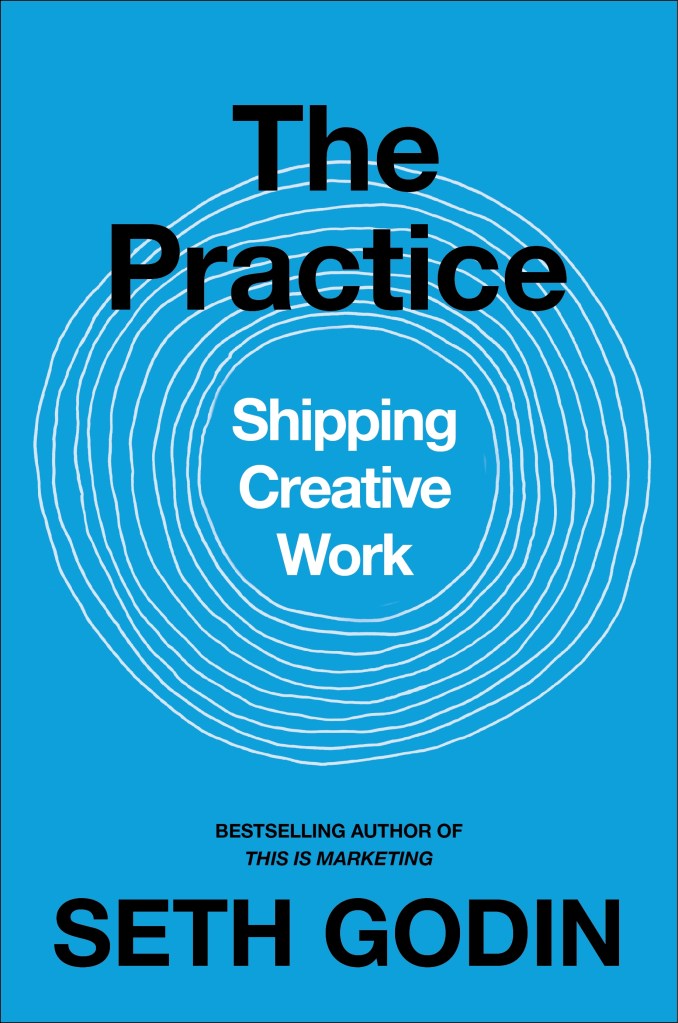
The Practice talks about a creative’s ‘practice’, and its main message is to encourage the reader to trust the process and ship the work. There are a lot of insights and principles bundled into a series of short lines bundled in micro-chapters. Those chapters link with others, jump topics, then make references back – so it’s best to read it in as few sittings as possible, and with a large screen. (I started reading it on a phone and it’s interesting to see how screen size affects my perception of the material. A post for another time?)
A coworker and friend bought the e-book for me at a pretty apt point of my life. I’ve been wondering about where to go from UX research, because I know being a UX researcher isn’t my end goal by a fairly long shot. I want to create, and two posts back I spoke about my feelings about being an ‘artist’, but it’s so hard for me to call myself an artist or a creator.
That makes sense, Godin points out, because I’m not creating at the moment. The whole idea is that I can choose to create, and I can choose to be creative.
I’ve outlined some of the key points I took away from this book, contextualised to my own experience and interpretation.
Point 1: You can’t afford to be confident.
I’ve been speaking about this with some people – Singaporean culture is pretty risk-averse, and my life journey so far has been about as comfortable as it gets. I’m used to going down well-trodden paths. So as I’ve been searching for what I want to do, even though I know full well I’m looking for something different this time, I thought I’d find a job posting or some knock on the head like yes, this is what I was looking for.
The Practice basically went no, that’s a contradiction. To create something meaningful (in this case, my life) is to be uncomfortable. “Confidence is a feeling we get when we imagine that we have full control over the outcome.” And to have control over the outcome is in some ways for the journey to be meaningless. So don’t seek to be confident. Instead try to trust that you’ll find a way through. Your work might be shitty. It might fail. But a good process will lead to good outcomes most of the time, and you need to trust that.
Point 2: Hospitality is good, comfort isn’t.
This is on a similar tangent of confidence and assurance. The book cites Marie Schacht, who differentiates between hospitality (welcoming people, understanding them) and comfort (reassurance, elimination of tension, soft edges).
“But art doesn’t seek to create comfort. It creates change. And change requires tension.”
This was a punch to the face for me, because for a long time I framed what I wanted to do as provide comfort for people. Patting them on the backs, giving warm cookies (literally and metaphorically). But how Godin frames it makes a lot of sense. I also get tired of gatherings that do the same thing with the same people over and over again, but all my energy comes back when it’s a new person I’m hosting, or a new combination of people, or we’re doing some activity that we’ve not tried before. There is always tension there, and I can feel it in my face or in my weak stomach, but it almost always turns out great. And if not, there’s a lesson learnt there.
“We commit to making people uncomfortable in the short run so that we can be hospitable later.”
(Can you tell this is a book designed to be quoted?)
Point 3: Do “user research”.
I mean, this is what I’m calling it for myself, but when Godin talks about understanding who our art is for and understanding what they need/want, I’m thinking this is user research. It probably doesn’t need to be formal in any way, but you need to understand the audience.
Audience is crucial, not just to receive your end-product, but to help you in your process. The way that you can take away self-consciousness and doubt about your work is by focusing on making something for someone. In a manga called Bartender (guess what it’s about), at one point there’s an apprentice worrying about pouring drinks for guests for the first time. The main character, who’s an experienced bartender, responds by telling him to stop focusing on his own screw ups and start focusing on making the guest has as good an experience as possible.
The audience is enabling in that way. For some reason I’m chronically nervous about posting anything on Instagram, but if it’s a case where there’s a photo or a memory that I think my friends would like to see, that gives me all the motivation I need to post it. It’s the same with this blog – there’s the voice that says “so you think you’re good enough to write about this topic?”, but concentrating instead on the hypothetical people who might find it useful gets rid of that voice.
Beyond the inner emotional factor, we make things so that others can enjoy them. It’s important to be sure that these things are really what people want. The book addresses this as ‘practical empathy’, empathising with the audience in an actionable and real way.
Point 4: Good work will not be for everyone.
This is necessarily the case, Godin says, and you need to be comfortable with the idea that your work will be for some people, and crucially not for others. This helps you get specific and hence more impactful on the audience that you target. It’s also a good reminder that sometimes there are contradictory groups of people – people with opposing beliefs, people who are suffer and allow others to gain. You can’t cater to both groups simultaneously. Or if you do, it probably won’t be very meaningful.
“A key component of practical empathy is a commitment to not be empathic to everyone.”
And I like this quote: “The ability to eagerly suggest an alternative to your work is a sign that your posture is one of generosity, not grasping.” There’s no need to compete with other art. There’s every reason to actively engage in what others are doing, see their meaning, and learn from them.
Point 5: Ask yourself “what’s it for?”, and know that all answers are valid.
Godin brings up a great example of this. Imagine there’s a meeting that happens every Wednesday that seems pretty routine and you’re not sure what it’s for. You ask a colleague who’s been around longer, and they say “we’ve always had this meeting”.
It might sound like the meeting is useless because that’s a seemingly empty answer, but truthfully there is a reason, and the reason might be important. The reason might be that “it’s easier to maintain the status quo than to risk not having the meeting. What the meeting is for is making sure that the people who like having the meeting aren’t upset.”
When you have the “what’s it for”, then you have metrics by which you can succeed and fail. Without these reasons, you lose sight of what you’re making. Without knowing why you’re building a website or planning a gathering, it can start to lose its shape and meaning. Knowing the reasons enable you to make intention action.
Point 6: You will be scared, and that’s okay. But don’t fake a reason for it.
Writers’ blocks, extending deadlines, setting unreasonable goals that you don’t meet, procrastinating, finding excuses to not get the work done. Those are all simply symptoms of fear. The idea is that yes, you’re doing something difficult and the outcome is uncertain, you’re going to be scared! But stare it in the face and don’t push it away to another reason.
I think at this point it’s appropriate for me to say that this is not for everyone. It’s hard to deal with anxiety and to throw yourself into the unknown, especially if you’re not feeling stable yourself. It can be difficult enough to just survive.
There’s still a good point to be taken from here, which is this: don’t lie to yourself! If you need a break, if you know you’re not able to do something for now, don’t do it. Take care of yourself and come back to it when you have the strength.
There are a few other points in the book: find your peers that you can connect with in your practice. Do the work every single day. Find obstacles. Make assertions and claims about your work. You don’t need to be authentic, just consistent.
It’s a quick read so I’d recommend it, especially if you’re at a turning point and looking for some guiding philosophy. It’s directed generally at ‘creatives’, but this is in the broadest sense of the word – if you like to ideate/build/make/write/change anything, it’s for you. This book isn’t going to tell you anything specific about craft or what your routine should look like, but it’s really a jumping off point for you to reflect on your own process.
In CGP Grey style I’ve set a theme for 2021, and for me it’s the Year of Adventure! (I know it may seem cringe but I am embracing it fully.) This book came in very clutch for that. I think I’ll be making some moves in my life and I’m excited to share about that. Stay tuned!

 joy wang
Leave a comment