
The mind-body divide
Let me start by asking you two questions:
- Would you tell people that you like music?
- Would you tell people that you like dance?
Most people I know would say the former, but not the latter.
Isn’t it curious? If you zoom out, music is as primal and innate as dance. The fact that both music and dance spontaneously arose in many ancient cultures across the world, and that many animals engage also in music and dance, is enough proof. Yet, most of us engage much more with music than with dance.
Today, we live in a knowledge economy. In school, from as early as possible, our brains are put to boot camp. Physical education, to train the body, typically occupies no more than 5% of school time. The rest of your school time revolves around textbooks. After graduating from mandatory school, the prestigious option to take is to pursue higher education and train your brain even more. You are told to aspire to work in a white-collar job, as that is where the money is. Even our leisure has become increasingly sedentary, as social media continues to capture more and more of our attention span, leaving us lying on the bed and swiping things away to feed our eyes.
In our society we have cultivated a mind-body divide, and specifically a hierarchical one. The mind tells the body what to do, and it is the body’s role to do as the mind says. What use is your body but to extract the value of the mental and intellectual mind? To type on a keyboard and use a mouse? To walk to the bus stop or put food into your mouth?
I have a small theory about why music is a more common interest than dance today. Music fits in much better with our knowledge-based age. Music can be enjoyed and performed sitting down, at a computer, while performing visual-intensive tasks like writing emails or making slides. Meanwhile, as watching dance is visual, it has to fight with this visual-intellectual space occupied by work. Don’t even talk about doing dance – it will require you to get up from your chair.
The fact, which the world seems to be ignoring, is that humans are physical beings first. We evolved that way, to run from or fight threats, to climb and roam, to build spaces and things.
Our bodies give us rewards for doing physical things. When you use your body, you gain flexibility and strength, which allows you to use it to even greater extents, or at least not pull a muscle. You regulate your nervous system and find ways to release the stress and fear you’ve been holding (side note: I think it’s crazy that nowadays we experience most of our fight-or-flight response while sitting in a chair). In older age, you stave off conditions like osteoporosis or dementia, and you preserve your mobility and independence for longer. And in each moment that you work with your body, you get endorphins that keep you feeling energised and happy.
I think we must all cultivate a better relationship with our bodies. There are many ways to do this, which many people have talked about – taking walks, running, going to the gym. These are all great and important.
But I would like to propose another really fun and easy way to get into your body: dance!
Why dance, specifically?
First, a clarification on what I mean by dance. Typically when we think of dance, we envision dance genres like salsa, ballroom or hiphop, or choreographed sequences (e.g. TikTok dances). Most people we see doing dance are trained, have danced for many years, and look good and coordinated.
Those are great to watch, but I’m not referring to a perspective on dance that is meant to be perceived by an audience. To me, dance is creative and expressive body movement of all forms. It can be anything from doing a body wave, to clenching your butthole. It should be deeply personal. The point is not for someone to see it; the point is for you to express yourself and however you feel inspired to move.
Dance (in this form) is an exceptionally easy thing to get into, for the following reasons:
- You don’t need any equipment or space. Dancing can be done without any limbs moving (see earlier butthole-clenching example, which is a gateway to twerking), so you don’t have to take up more space than your body already occupies. No fancy equipment or venue is needed either – your bedroom, the train, the toilet, even your office chair are viable places to dance. You might want something that produces music (e.g. a phone), but you could just turn on the song in your own head, or dance to a pure vibe.
- It doesn’t require a set amount of time. It can fill whatever amount of time you give it, whether it’s the duration of your favourite song, or two seconds while hearing a song blasting from a passing bike.
- There is no ‘wrong’ dance. Any movement counts as dance. It just has to be for fun for you.
- It builds on your pre-existing enjoyment of music. If you have some favourite songs or artists, it’s naturally easy to move to the next step of moving to said music – tapping your fingers, nodding your head, swaying. Chances are you already do some sort of dancing to music you love, I’m just asking you to give yourself permission to do more.
- It’s a perfect social activity. If you’re looking for connection with others (and face it, who isn’t), you can join a social dance community – there are salsa classes and interest groups in about every major city. Or you can go to a club, join the many others letting go of their minds and stepping into their bodies. When you’re dancing, there is no need for small talk or present your carefully curated self to establish a connection; all you need is to simply move in rhythm with others.
Additionally, a meta-analysis of 218 studies on treatments for depression in the BMJ found that dance had the strongest effect, more than SSRIs (most common anti-depressant medicines), cognitive behavioural therapy and many types of exercise. Dance could be the best cure for depression we’ve got. And even if you don’t have depression, think of all the things it could do for your mental and emotional wellbeing!
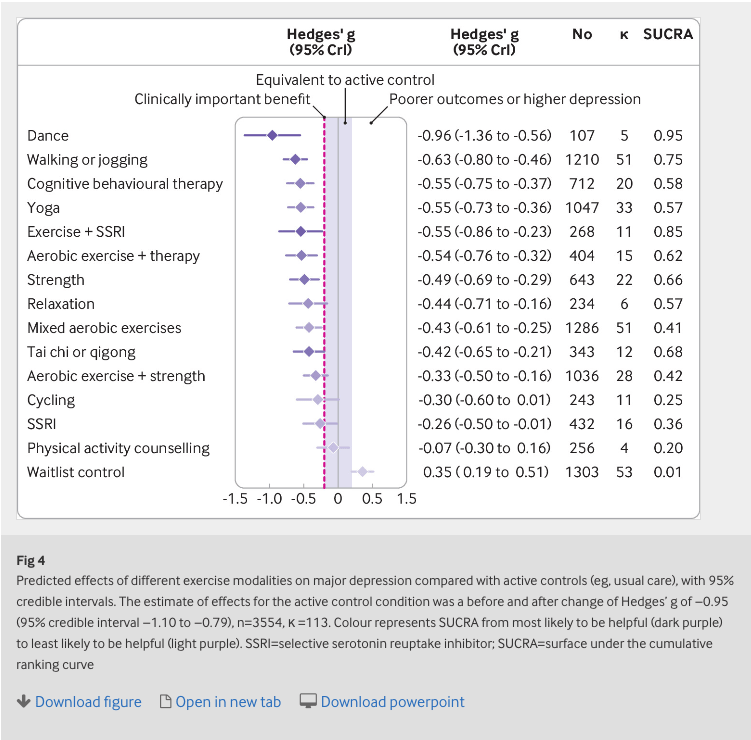
(As a note, the researchers hold back on strongly recommending dance because of the studies’ limitations in the set-up and sample size. Can’t hurt to try though.)
Apparently, dance also decreases risk of developing dementia by SEVENTY-SIX (76) PERCENT (%)!!!! This was the leisure activity with the strongest effect size, beating out reading, playing board games, and playing musical instruments.
How to get started
I really get that it can be intimidating to start. As I did, you might have tried emulating some moves in front of the mirror, and felt embarrassed at how stiff or uncoordinated you look. You might have gone to a club or at a party – a place where people are expected to dance, and most of those on the dance floor are really tearing it up – and meanwhile you’re worrying that you’ll look like an awkward try-hard loser, watching as everyone else gets complimented but you. Those fears will, of course, make dancing utterly unenjoyable. It’s so much more comfortable standing against the wall, holding on to a drink and trying to having a conversation with another shy person, right?
It can be hard to change your circumstances. Very well someone in the club is dancing better than you; possibly even everyone are. But I believe that you can get on the path to full expression, and enjoy yourself completely along the way.
Here are my steps for getting started on dancing.
Step 1: Change Your Mindset
Sorry. You will need to kill the part of you that cringes.
Yeah, you might look funny. That doesn’t matter at all. I can tell you that no one will ever make fun of you for dancing ‘badly’ if you look like you’re enjoying yourself. People who do give you bad vibes about it are assholes and not worth paying attention to. You might need to switch off your brain a little for this at first – some people turn to alcohol, but I don’t think it’s a good thing to rely on. Just tap into your primal head-empty self!
Also, I want you to know that the only thing that matters is the energy you bring to dance. You are only going to get what you give; you will only get as much fun and energy from it as the fun and energy that you put in. A surefire way for not enjoying dancing is to lean at the corner and watch the dancers and try to look cool while you sway your head a little. What good are you getting from that? Step onto the dance floor. Put in the energy. And it will give it back to you.
If you go with friends, hype each other up! Cheer, clap and whistle! I get inspired by street dance/hip hop culture, taught to me by my friends who are hip hop dancers themselves – you gotta stand up and be loud and cheer on, so that the dancers can receive that energy and send it back out. Likewise on the dance floor, be the hype mans you all want.
Step 2: Choose Your Music
Now you can dance to anything – no music, just vibes. But it’s easiest to start with music, and you’ll want to pick the right ones.
First, pick music that you like. It’s easiest to get into the dancing when you know the songs intimately. They don’t always have to be songs that you love the most; my favourite songs to dance to are 2000s-2010s pop music, which I will never cite as my favourite genres, but are certainly the ones I get into the most for dancing.
The music should also be something with a consistent, clearly discernable beat. Thankfully, 99% of music we listen to will qualify, except for ambient music like this, or free jazz. The more layers of rhythm there are, the more danceable the song. This element is what clearly separate ‘dance music’ (think jazz, house, afrobeats, bhangra, dance-pop) from music that I would say is… less danceable, like emo rock. Emo/punk rock has a clear rhythm for sure, but they tend to overly emphasize consistent, equidistant beats, meaning that the most appropriate movement is to headbang, or jump. Up and down. Nothing more.
For example, see Mr Brightside by The Killers below. It’s a classic song that most people love at the club, but admittedly not the most inspiring of different dance moves.
In comparison, more danceable music will have some layers – e.g. through different instruments playing on different beats, through syncopation where beats are not so regular, but have a sort of swing to them. This sort of works because your body is made of many different joints, and joints attached to joints, which can all be activated to move at different little sub-beats.
Don’t think about it too hard though. Listen to another great song for clubbing, Promiscuous by Nelly Furtado ft. Timbaland.
Notice that the drum beats are more varied, not all consistently spaced out like in Mr Brightside. And there are little layers of synths in the back that vary things even more.
I also think the song should have some attitude. This usually means a song that’s slightly upbeat and won’t put you in a sleepy mood. But it also comes down to the artists and the type of energy they’re giving to the song; this is the base material for you to absorb and put into your dance. Both Mr Brightside and Promiscuous have plenty of attitude, and I’m sure you can find more from songs that you like.
Lastly, if you’re looking to go for a dance party/clubbing, make sure you pay attention to the kind of music they’re playing, and that it matches the genre you’d get excited about. Don’t feel pressured to go for a techno rave if it’s not the stuff you’d bop to.
Step 3: Move!
Now that you’ve prepped yourself for dance, it’s time to move. I’ll let you explore moving in the styles that you want, there are far more experienced people than me on this subject. But here are some tips that I found worked for me:
- Play around with your limbs and joints. Any of them can be flung around, in whatever which way. Identify them, from your neck to your shoulders and hips, elbows and wrists, legs and knees.
- Shift your weight. Lean on one leg, then another. Bend your knees and lower yourself. Explore swaying. Even walking on the spot shifts your weight from leg to leg and can work as a basic dance move.
- Shift your core. The best bits of your body to groove to music are your torso, namely your hips and shoulders. These can sway and tilt left and right.
- Search up some random dance videos or tutorials and try emulating them. The point is not to nail them perfectly, but to gain inspiration for what you can do spontaneously.
- If you’re in the club, try copying other people around you. It’s not just a way to pick up new moves, it’s also a way to bond and make a new friend – it can automatically connect you.
- Get expressive! By this, I mean with your face and movements. I love doing interpretive hand signals/movements to the song lyrics, and being really expressive with my facial expressions. These keep adding fun into your dance.
As you try all these, it might be really stiff and you may not be able to move as much as you hoped. Remember that your muscle flexibility and strength will grow over time, so you will only get better at moving. For example, to learn how to twerk, you have to learn how to activate a muscle in your lower back that you’d probably never use. That stuff takes time and repeated practice, so just keep doing it!
Another thing I want to say is that you can do the same moves over and over. Don’t feel pressured to always be changing up your dance moves. You should do whatever feels natural and easy.
I really hope I’ve convinced you to dance. Not just because it’s a natural part of life and being human. Not just because it’s good for you in every possible way – physical, mental, emotional, social. Not just because you can do it anytime, anywhere, in a world where hobbies and exercise are starting to cost lots of money.
But also because I’m also looking for friends to dance with. If you ever need a supportive dance friend, I will be there.
See you on the dance floor!
This post is adapted from my presentation for Teck Whye Convention’s 5th Edition.


 joy wang
Leave a reply to roebrs Cancel reply